
In metallurgy, the pursuit of superior material properties is relentless. This is especially true in the ferroalloy and cast iron sectors. A critical tool in this endeavor is the inoculants. These master alloys are added to molten iron. They act as catalysts for microstructural transformation. They do not drastically alter the chemical composition. Instead, they fundamentally improve the solidification process. This enhances the mechanical properties, machinability, and consistency of cast components.
Global manufacturing demands higher performance, efficiency, and sustainability. Therefore, inoculant technology has become a key differentiator. This article explores the primary types of inoculants. It details their applications across industries. Finally, it provides a comparative analysis of domestic (Chinese) and international products.
Core Types of Inoculants in the Ferroalloy Industry
Inoculants are designed to provide effective nucleation sites within molten metal. They primarily influence graphite formation and matrix structure in cast iron.
Silicon-Based Inoculants: The Industry Workhorse
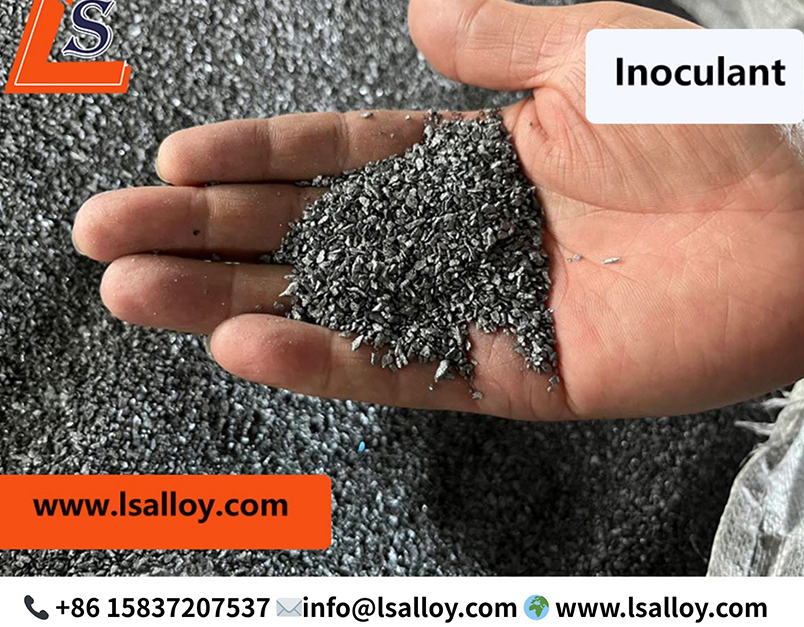
The most prevalent category is silicon-based inoculants. They utilize ferrosilicon (FeSi) as a carrier for active elements.
?FeSi: The basic form, providing silicon and acting as a graphite nucleant.
?FeSiBa: These incorporate Barium (Ba) for a powerful, longer-lasting (anti-fade) effect. FeSiBa is particularly valued for heavy-section castings. It is also useful when there is a long time between treatment and pouring.
?FeSiSr: Strontium (Sr)-bearing inoculants are highly effective. They reduce undercooling and prevent chill (carbides) in thin sections. They are favored for castings requiring high pressure tightness, such as engine blocks.
?FeSiCa & FeSiZr: Calcium (Ca) aids in desulfurization. It also improves nodularizing efficiency in ductile iron. Zirconium (Zr) enhances high-temperature stability for heat-resistant applications.
?Complex/Composite: These combine multiple elements (e.g., Ba-Ca-Al, Sr-Ca-Mn). This achieves synergistic effects. They target specific challenges like shrinkage control or improved machinability.
Specialty and Advanced Inoculants
?Cored Wire: The inoculant powder is encased in a thin steel strip. This allows for precise, automated addition into the ladle. It significantly improves recovery rates and reproducibility. It also reduces fume emissions. This method is standard for modern, high-volume foundries.
?Nucleating Precipitates: These inoculants are based on carbides or nitrides (e.g., containing Ti, V, Nb). They are used to refine the grain structure of the matrix itself. This enhances strength and wear resistance.
?Nanostructured: This is an emerging frontier. They utilize nano-sized particles to provide a high density of nucleation sites. Due to cost and dispersion challenges, they are still largely in R&D. However, they promise unprecedented control over microstructure.
Cross-Industry Applications of Inoculants
The benefits of effective inoculation translate into performance and reliability across diverse sectors.
Automotive Industry
The drive for lightweight yet strong components makes inoculation vital. FeSiSr and FeSiBa inoculants are used extensively. They are found in engine blocks, cylinder heads, brake discs, and hubs. They ensure a consistent, chill-free microstructure in thin walls. This improves fatigue strength and pressure tightness. It also reduces scrap rates.
Energy & Heavy Machinery
Components for wind turbines and mining equipment face extreme loads. Inoculants like FeSiBa ensure uniform, fine-grained structures. This is critical throughout thick sections of ductile iron castings. They provide the necessary toughness and fatigue resistance for decades of service.
Infrastructure & Piping
The global ductile iron pipe (DIP) network relies on consistent inoculation. This is often delivered via core wire. The result is pipes with a uniform wall structure. They also have excellent corrosion resistance and high mechanical strength. Proper inoculation prevents brittle cementite formation.
General Engineering & Machine Tools
From pump housings to machine tool beds, inoculants improve cast iron parts. They enhance machinability, damping capacity, and wear resistance. This leads to longer service life and lower manufacturing costs.
Emerging Frontiers
Inoculant technology is adapting to new trends. Special formulations are being developed for high-recycled-content melts. This helps counter impurities like Titanium. They are also being developed for castings from 3D sand printing, where solidification is unique.
Conclusion
More than just an additive, inoculants are the cornerstone of modern casting. By precisely controlling microstructure, they empower innovation across automotive, energy, and infrastructure. As technology advances, inoculants will remain central to casting a stronger, more sustainable future.